Sunday, March 3, 2013

Arts & Sciences Track: Week 1


After spending last week working with different cooperatives in small villages, it was nice to reunite as a group back in Oaxaca city this week. First thing Monday morning we had class at SURCO, but this time we were the teachers. Each group put together a short presentation about each cooperative to give the rest of the group a better idea of how everyone spent their week. It was interesting and informative to learn how different each cooperative was and the unique experiences of all the group members.
            Tuesday kicked off the first day of our tracks, which means you will all now have three different blogs to read every week! As members of the Arts and Sciences track, we went back to Solexico for our fifth and final week of Spanish classes. The majority of us were in the same class and were intrigued by our new professor, who really just wanted to chat with us in Spanish. After talking mostly about riddles and jokes and then playing BASTA, the Mexican version of scategories, we realized this final week would be more fun than tough. We did have to complete a final exam and hand in one last paper, but then we were taken out to cafés and mercados as well as chocolate factories and museums. I think we all felt that this was a great way to improve our conversational Spanish skills and get to experience more of the city that we had not yet.
            At our group meeting on Thursday, Mary Lucia passed out our village stay reflections and gave us a few moments to read them over and think about any other realizations we might have come to since writing them. We then went around and, based on our village stays, shared one thing we wanted to start doing for the remainder of our time here and one thing we wanted to leave behind. It was very beneficial to hear what everyone had to say because it made us think about things we might not have thought about otherwise.

            Friday counted our final day at Solexico and it was a bittersweet goodbye. We are all excited to move onto the next phase of our trip, but a lot of us will be missing Spanish class. As the weekend rolled around, Mary Lou informed us of some cool and uniquely Oaxaca things to do. On Saturday morning a handful of the group went to Abastos, a market that had an infamous reputation and lets just say you should not wear nice jewelry and you should put your money in your pants. You can also expect to see the unexpected, such as a box of crayola-colored chicks. After about two hours of walking through an overwhelming and massive market, and not passing the same thing twice, everyone went home for comida. But the day was not over yet! There was a traditional dancing event going outside of El Soledad, one of the many churches in Oaxaca. Although we were hit with some of the coldest temperatures we have had here, some of us still went to enjoy the festivities and it was completely worth it!
            As we look towards next week, the Arts and Sciences track will begin our music class and we are all thrilled to start that adventure!

Con mucho amor,
Brittany and Kathleen 

Food Systems Track: Week 1


As the first week of our specialized tracks comes to a close the wild reality that we're well into the second half of our trip is setting in!

The ingredients we collected at the market
Our week began by wrapping up our village stays. On Monday morning we all gathered, and group by group shared our different experiences to compare and learn about commonalities and differences between all of our experiences in the villages. Then it was time to part with our village stay pals and regroup into our new groups for the tracks that we will be in for the remainder of our stay.

And so the food systems track began our first course: Food, Culture and Health in Oaxaca. We started out by completing some introductory readings and response questions about the cuisine and culture in Oaxaca online by Tuesday night because our first professor, Amy Trubek, had not yet arrived in Oaxaca.


Wednesday morning we met with our teacher's assistants, Amber and Carey, to travel to Etla market, a larger market that was a bit of a bus ride away. Once we got there, our assignment was to split up into three groups to collect designated ingredients and to label what they were; the groups either had to purchase as many chilies, herbs, or spices as they could with 100 pesos. This proved to be more difficult for some groups than others, as often things referred to as spices, we may normally call herbs or seeds and vice versa. But nonetheless we completed our task and even made it back in time for comida in the city!


Our professor Amy arrived Wednesday night and we met her for the first time at Solexico on Thursday morning. We discussed our experiences here surrounding food thus far, learned a bit about Amy and what her experiences have been, and finally, we laid out the ingredients that we collected at the market the day before on a table. We tasted the ones we knew, and tried to identify the ones we did not.

 
The group in Huayapam
Friday morning we met with Amy and walked to a small nearby market together. We did a tasting/sensory evaluation of atole (a popular corn based drink in Oaxaca) and of champurrado (the atole drink combined with chocolate). We then walked around the market and tried to pick out what we thought were the primary fruits and vegetables, as well as some of the not so common ones, and to note any we could not identify. After, we returned back to Solexico to share what we had found. We then moved to our discussion surrounding tejate, another popular, historically significant cacao/corn based drink in Oaxaca. In the market Amy bought a mamey fruit, as the seed of the mamey is actually a crucial ingredient for the tejate. We were all more than happy to help her eat the mamey itself, which we decided has the consistency of an avocado but looked and tasted something like a sweet potato. We discussed the process of making tejate and started to prepare for our visit to a small pueblo outside of Oaxaca which is famous for their tejate, called Huayapam.

The Rosita de Cacao tree
We arrived in Huayapam on Sunday morning and began by taking a walking tour of the town to see the tree with a special necessary ingredient for the tejate making process: the Rosita de Cacao. Huayapam is said to be the only pueblo that grows this tree, so it is one of the reasons why their tejate is special. Ater that we went to a restaurant owned by a local couple for a tejate making demonstration, a process that requires far more skill and technique than any of us could have imagined. 
    
The tejate making process
When it was finished, we had the pleasure of tasting this unique Oaxacan drink. It is quite rich and filling so we then took a walk to the church to work up an appetite for the comida they were preparing for us. It’s a good thing we did because the food just kept coming and coming! We sat around a table with our hosts and discussed some of the looming questions we had about our observations before heading back to the city to hopefully finish, but perhaps get started on, our first food systems paper due in the morning! 

Next up, a week full of cooking (and of course eating) to look forward to!

Abrazos y Besos,
Olivia and Sandra


Spanish Track: Week 1


Train accident posters
This week we started off our Spanish class that is taking place at the local university here in Oaxaca (UABJO).  The class we are taking for these next three weeks will explore the history and culture of Oaxaca.  There is just the two of us in the class, but our professor, Edith, is super snazzy.  Our first day was on Wednesday.  We went over the syllabus and then jumped right into the material.  Since it is just the two of us Edith has allowed the class to be very flexible and we get to choose if there is some aspect of the course we really want to focus on.  Between Wednesday and Thursday we had six hours of lecture about the geography, history, and regions of Oaxaca.  Within this we covered aspects from the pre-Hispanic period up to the independence of Mexico.
A tiger sculpture in the old train station

Over the two days we learned a lot about the Zapotec and Mixtec people along with major leaders such as Benito Juarez and Porfirio Diaz.  We also learned about traditional foods and clothing of Oaxaca from the pre-Hispanic period.  After all this information was thrown at us we got to go on two great field trips to put some meaning to everything Edith had told us!


On Friday we went to a market called La Merced to try some of the foods we had heard about.  We tried a certain type of vegetarian tamale, empanadas with the flower of a pumpkin in them, along with champurrado, which is a chocolate corn drink.  All was delicious and afterwards with full tummies we drove around the city with Edith seeing different neighborhoods and streets that were important to the leaders we had learned about.


On Sunday, we tried to go to Monte Alban for our second time, but we were not able to because we are not nationals like Edith, so we could not get in for free like Edith.  So, back down the hill we went and stopped at an old train station just to look around.  We took lots of pictures for Edith…she loves posing.  Unfortunately, they are all on her camera so we only have a few of us and some sites we saw.  The train used to run from Oaxaca to different pueblos throughout the region.  Around the abandoned tracks were posters of different train accidents that occurred, which were interesting to read about.  

A codex in the museum
After the train station we went to Santa Domingo to walk through the gorgeous museum there.  We spent three hours or so walking through and seeing everything the museum had to offer.  It was very cool to see the change in artifacts from the pre-Hispanic times to the conquest time.  We could really see the influence that the Spanish had on the way of life in Mexico and Oaxaca.  There were many artifacts there that were found in Tomb 7 at Monte Alban along with many different figurines that had great meaning to the Zapotecs.  There was also an exhibit outside of different canoes that people used to use.  The way the exhibit was set up was very artistic and fun to look at and walk through.


So far we are loving the class and how personal it is.  We have lots of other fun trips planned so look forward to hearing from us next week!

Abrazos y Besos,
Gabby y Torey

Monday, February 25, 2013

Our Week in Bii Dauu !


On Sunday afternoon we arrived at the Bii Dauu cooperative, a Zapotec weaving community located in Teotitlán del Valle. We were warmly greeted by the cooperative members as they discussed the origin and mission of the Bii Dauu weaving cooperative as well as our schedule for the week. We each followed our respective host families to their homes and settled into our accommodations, preparing for the activities of the coming week.


We woke up bright and early Monday morning and trekked to the Huerto (a hillside garden in which the community grows plants used to create various colors of natural dye). We learned about the nopal cactus that is home to the Cochineal beetle (the source of the red dye) and plucked the seeds from the Marush and Añil plants (the sources of the yellow and blue dyes, respectively). After some hardy work, we sat down with a few members of the cooperative, chatted, indulged in some mezcal from a bottle that contained a few scorpions, and enjoyed some traditional dancing. After a gigantic comida (which seems to be the norm in Teotitlán del Valle), we attended a demonstration on the ancient Zapotec art of weaving. We were even provided with our own tiny looms so we could create our own tapetes pequeños (tiny rugs)!


Tuesday arrived with great excitement as we all got up at the crack of dawn to go on our hiking/biking adventures for the day! Our morning started off with a kick…more of a fall, with Enya’s grand attempt to jump over a curve while on her bike…instead, the ground greeted her fall. It was quite entertaining.  After that show, we trekked along the mountainside, making our way to the peak where a mesmerizing view awaited us. The peak holds great meaning to the Zapotec community. It is the connecting point from Monte Alban and La Cuevita. After hiking downhill, we got our bikes ready and enjoyed a long ride around the pueblo where we got to see the picturesque mountain views as the fresh air filled our lungs. Although the uphill encounters and scorching sun hit our backs, we still made it to the final destination: La cuevita, where many members of the Zapotec community go to pray each December 31st. To finish our adventurous day, we all went exploring around the town, and looked at the colorful tapestry being displayed around the shops. It was a great ending to a lovely day!

After an exciting day off, we returned to the huerto Wednesday morning to make piles of compost. This consisted of layering mostly organic waste/garbage, chopped up nopal cacti, and dirt. Every completed layer was watered to escalate the composting process.
The nopal cacti we used were taken from the plants originally planted for cochineal production but that had failed. The fun part of the morning was using a machete to chop them up. In the afternoon, we met at the cooperative store to learn how to naturally dye wool. We began with the cochineal beetles. They are grown on nopal cactus leaves and the leaves are then harvested to collect the beetles. Once the beetles are collected, they are allowed to dry. The dry beetles are then ground up by hand to produce a dark red powder. The blue añil color is applied by fermenting the plants and then allowing the wool to soak for twenty minutes (more or less depending how dark a color is desired). What is interesting is that when the wool is in the water, it is green, but the second it comes in contact with oxygen, it turns blue. This is where its nickname, el tinto mágico (the magic dye) comes from.
 For the yellow color, the marush is boiled for a few hours until the water turns yellow. It is then poured through a strainer to remove the plants and is used to dye wool. The wool is not removed until it has absorbed all the color and the water is clear. After we ate comida, we went back to the coop to see how the dyes were progressing. With our free time, we explored the town and bonded with our families.

When Thursday finally arrived, we all had mixed feelings about our last full day in the cooperative. We were sad to be leaving our new families but also a little excited to return to the missed luxuries of the city, like internet and things to do at night. The day consisted of some more work in the huerto followed by a spectacular comida and then we all met up at one house to finish...or start...our personal tejidos. Several women helped us complete our mini squares and have something to show off on the final day that we could all be proud of. Some of us spent the night at our favorite waffle place and we all had some great bonding time with our families.

On Friday morning we woke up to our last breakfast with Bii Dau (which was very sad) and headed out to the market where many people from Teotitlan reunite, chat, and buy their daily groceries. It was lovely to see the community come together and get a taste of some delicious local food. After the market, each of us were given a handmade present from our host family- from scarves to bags to pillow cases. Later that day we all came together for a final fiesta! Each family had prepared a good sum of food and we all came together at the Bii Dau cooperative to celebrate our wonderful time together, show off the beautiful textiles that we had made for the week, to thank our host families for a magnificent time and for their great hospitality, and finally Adrianna's birthday! At the fiesta each of us received a lovely certificate that showed Bii dau's gratitude for our presence and help on the huerto. As the fiesta came to an end we said our goodbyes, wrote our appreciation for our stay in their blog book and headed back into Oaxaca city.

Con Mucho Amor,
Brittany, Kat, Kathleen, Sean, Reed, Adrianna, Kristi & Enya

Sunday, February 24, 2013

The Vida Nueva Experience


      Upon arriving in Teotilán de Valle, a Zapotec municipio about an hour bus ride from the city, our group was received by the entire Vida Nueva Cooperative in the founder's house (Pastora).  The women were extremely warm, welcoming and seemed very excited to see us. Pastora’s home was dedicated to weaving- looms and yarn were everywhere we looked. We all sat down at a long table and chatted about the cooperative. The group was founded 14 years ago in an effort to gain solidarity for women weavers. Since their beginning, the women have started many initiatives to better Teotitlán as a community such as providing garbage and recycling receptacles, chimneys for in-house ovens, gift baskets for single women and urban gardening. 
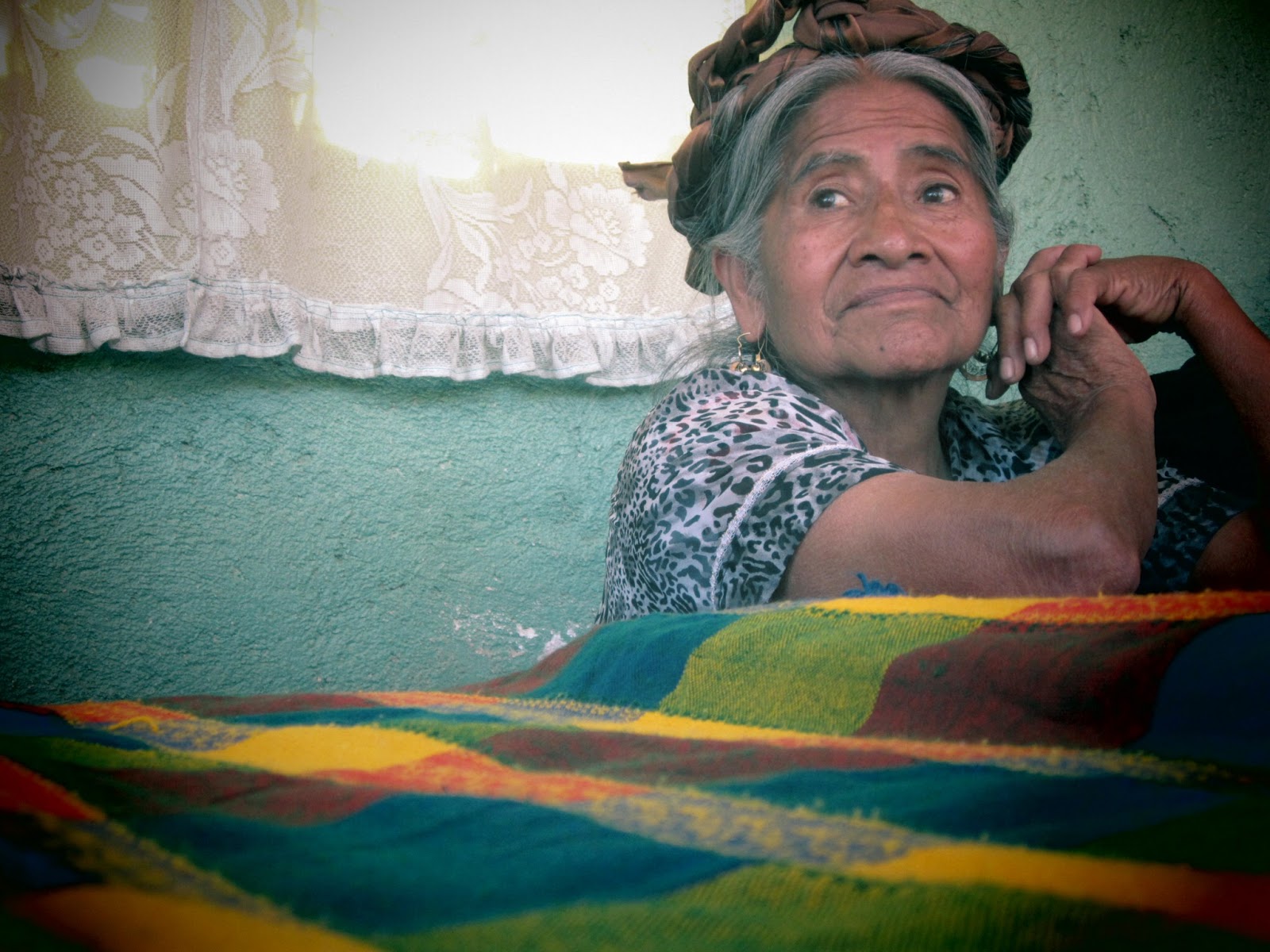
Isabel rocking her leopard print and traditional braids

      After our chat, it was time to eat. The ladies brought us pitchers of horchata, rice with a dank salsa, and some delicious tacos. Needless to say, we ate ourselves into a stupor. After eating, we continued chatting. The women showed us some of the raw materials they use for dying yarn and how they acquire them; pretty interesting stuff. The conversation eventually died down and we were assigned ‘parents-‘ shout out to my host mum Teresa! We all headed home for our first night in Teotitlán.


Our morning routine consisted mostly of hot chocolate and sugar pan. We normally woke up around 7:30, had some chocolate and bread, and then headed to the market with our mamas. We normally spent about an hour at the market in the center of town, picking out ingredients and prepared foods to sustain us for the rest of the day. Once at home, our host mom’s prepared us a second breakfast…quesadillas on homemade tortillas, rice, vegetables, huevos, frijoles….etc. Post-desayuna on Tuesday, we had a really informative platicar with the lovely ladies of Vida Nueva. We spoke mostly about what it was like to be a woman in Teotitlan—their rights, struggles, and successes as females in the community. Women have increasingly been breaking free of their traditional, oppressed roles in the community, and have been granted greater access to education, a say in who they want to marry, and rights to go into the city of Oaxaca. That being said, we were surprised to hear that many of the women we were speaking with only had up to a primary school education. 
working on making dye

Later on in the week, we had another platicar led by Pastora about the use of traditional medicine in Teotitlan. She suggested going for daily walks by a river and hugging young trees for stress and depression relief, as well as a variety of herbal remedies for different types of sickness. Apparently a lot of people in the village are turning to western medicine, as it offers faster relief for their symptoms. We also got to participate in the dyeing of wool. We learned about how different fruits and vegetables are used as natural colors. For instance, the cochinia red beetle and pomegranate are used for red dye, and an avocado-like fruit (that we all got to smash up with rocks) is used for brown dye. The basic process for dyeing wool is as follows: Heat a big thing of water with the fruit/vegetable, let it boil for awhile to let the water absorb the color, and the yarn, stir it up and let it sit.

maiz de muchos colores al campo

fun with corn!

     Wednesday morning the group piled into some taxis clown-car style and headed north to spend a day at the ‘campo’—a milpa farm about forty minutes outside Teotitlan. The air at the campo was crisp, and the breeze was a long-awaited break from the scorching city sun. Upon arrival we sat in the grass and at fresh fruit under the shade of a tree. Later that day we helped the women husk what seemed to be an endless supply of harvested corn. Each unwrapped husk revealed a new cobb of varying colors and shapes. Working alongside the women with the knowledge that our work would translate to months of food for them was unbelievably rewarding. After about two hours we broke for picnic of tortas (Mexican samwhiches), beans and tortillas. The rest of the afternoon we reclined in the grass, trekked freshwater back from the well, cut flowers to sell at the morning market and enjoyed the company of friends. With dirt-covered hands and full stomachs, we bid adios to the campo and made our way home.
chilling at the farm

      Thursday was a free day.  We all spent time with our host families and getting to know their day to day home lives a little bit better.  Family time continued into Friday until we left the village to return to the big city.  It was a great break and an amazing experience for all of us, but we were also all really happy to be returning to our lives in Oaxaca.  What we all experienced in this past week is something that many attending UVM never will, and we are so grateful for that.  
      Here is a little Zapotec that some of us learned!  Zapotec is the first language for many in this village while Spanish is their second, just like us!
zac xtili: buenos dias: good morning
zac chi: buenos tardes: good afternoon
zac shni: buenas noches: good night

Abrazos y Besos de Oaxaca!
La Vida Gang (Patrick, Codi, Jess, Amanda, Olivia, Gabby, Elena, and Gretchen)


x

A Week in El Carmen


Friday (2/15):
Before our  stay at the agrarian village of El Carmen, we were first invited to the grand-opening fiesta for a new production facility.  Centeotl (a reference to the god of maize), the non-profit organization with whom we we’ve partnered, has been working with several villages throughout Oaxaca to find adaptable focuses that may help to develop both the community and its local economy.  In El Carmen, the focus in this past year has been the cultivation, consumption, and sale of a crop called “amaranth”—one that is abundant in high-quality proteins, vitamins and minerals, and may also be made even more profitable by making tasty treats called “alegrias”.  Since the village’s dry climate throughout most of the year is so hostile for the cultivation of most crops, malnutrition and poverty remain serious issues.  While there is no silver-bullet, amaranth’s ability to grow in these conditions may provide both a cash crop as well as added nutrition for the community throughout the dry season.  Centeotl recently provided the funds to build an amaranth-toasting machine—a necessary procedure in accessing the benefits of its consumption, as well as making it light and crispy for the alegrias—which began its operations on Friday.

With the due date for a final paper looming, a small group of us hopped onto a bus en-route for Zimatlan in the morning.  We weren’t going to begin our immersion experience until Monday, but Nicandro from Centeotl invited us to both an introductory meeting and later a fiesta in El Carmen.  When we arrived, however, we were surprised to find other Americans in the conference room, checking their iPhones and prepared to listen to a translated version of the presentation through radio-headphones.  It turned out that these people were prospective donors to the organization and that the ensuing activities throughout the day were targeted toward them.  We could go on for hours describing how oblivious these people looked, or how bizarre our interactions were (for example, after asking about our purpose in attending, one woman asked Caleb: “So if you’re not here to help, what are you doing?”), but the important part was experiencing and appreciating the day for what it was.  Of course, some of the community’s activities felt a little staged or insincere, but that exposed us to the importance of funding.  Without these donors, much the development that the community has seen wouldn’t be possible, so the community—in coordination with Centeotl—needed to appeal to them.
Our bedroom!

Afterwards, we returned to the city of Oaxaca and discussed the village, reflecting on the day and looking forward to the week ahead.  We had to remind ourselves that the experience to come would be much different.


Monday (2/18):
Arriving in Zimatlan, we met up with Nicandro and were transported to El Carmen. It is a small village, quiet, calm and hot. Nicandro, a man that has worked with Centeotl for over 19 years, brought us to the house of Gloria, the village promoter for the amaranto (amaranth). We chatted about the village, the project and its history. After the chat we were brought to our respective homes. Josie and Torey bunked with la maestra Amber, Phoebe and Sandra set up camp on a cozy concrete floor with Carey and the boys (Corey and Caleb) bunked down with a happy and welcoming couple. Once we had settled in we expereinced our first little taste of the tradition of comida. Talking with our families we began a relationship that would only grow over the next several days to evolve into something truly special. After comida we attended an Ahorro meeting. This project gives women the opportunity to create a savings account and apply for loans. There is no outside source of authority, the positions in the meeting rotate among women and the money never leaves the village. To our surprise, there was a fiesta planned celebrating El Dia de Amor. What did this entail? Food, too much food, a tradition that would continue throughout the week (Let this concept of too much food be summed up in a quote emitting from a mouth full of tamale and atole: "I can't believe I ate seven tamales today"). Returning to our homes, exhausted, stuffed and slightly dehydrated we were offered more food, politely declined and crawled into bed (onto the floor), fell deeply asleep, spiders and alacrans slithering over our dreaming toes.

Tuesday (2/19):
We awoke to the sound of roosters squawking and morning sunshine tumbling over orange mountains. After eating a delectable breakfast of beans, eggs, assorted breads and sweetened dark coffee, we met Gloria and began our hike over dirt roads and up rocky hills to visit houses of several families within the community. Our purpose was to encourage people to grow amaranth and to give pride and confidence to those who already grow it or wish to. The idea behind this can be explained in a quote by Nicandro: "When I go into a community, about 50% of the people will listen to what I'm saying. But if a pretty eyed foreigner comes in, 90% listen." Upon first thought, this approach might appear a bit manipulative, but when we thought about it, we were glad to fill that role in the name of a good cause. Our visits seemed successful in regards to this, as most of the people we spoke to expressed interest and pride in growing amaranth. Aside from amaranth, we spoke with each household (five in total) about their life in El Carmen, most of them having lived there their entire life. We were touched by the sweet hospitality of our visits as we were consistently brought chairs to sit on and cool water to sip on under the shade. They weren't necessarily expecting company, yet they took time from their days to talk with and care for us. After walking from house to house for hours, we were all pretty wiped and ready to relax with our families by comida time. After eating, we napped and then headed back out to sit in on another micro-financing meeting of women. Day turned to dusk, as we sat in a dusty soccer field, contemplating the events of the day. Walking back home under the star-speckled navy sky, we were feeling rather lucky to be in such a big-hearted place.

Wednesday (2/20):
On our third day in the village we woke up early with plans to go on a hike. We arrived at Josie, Amber and Torey’s host family’s house only to find out that their family was going into Oaxaca city. They told us that they would be back in an hour and we would leave for the hike then. This is a perfect representation of the time schedule we were on because it takes an hour and a half to get to the city from El Carmen. Instead the eight of us left for the home where the rest of the girls were staying to do some harvesting in their garden. The rest of our day consisted of walks about the village, fruit gathering (and eating), an amaranth bar or allegria making workshop, more amazing meals and much chatting. Some of us went to a fiesta that evening while others built card houses with their family. Finally we settled down for our last night's rest in the village.


Thursday (2/21):
As Thursday quickly hit us, we dreaded saying our goodbyes to our new families. Before having to face this sad reality, we all went to the market in Zaachila, a nearby town. There we had a delicious traditional breakfast, then wondered through the market where there was an endless supply of fruit, clothes, mescal, livestock, and more. Once we returned to El Carmen we were lucky enough to see the process of producing bokashi, a Japanese organic fertilizer consisting of manure, sulfate, molasses, ashes and other natural ingredients. We learned that a group of women in the community are trying to promote this fertilizer in hopes to, eventually, get every family to practice this for their personal gardens. Once this was finished, we returned to our host families where it was finally time to leave. All of us expressed our sincere appreciation for all of the generosity given to us as well as the meaningful conversations throughout the quick week; it is safe to say that genuine feelings of the experience were mutual among our families as well. We eventually left El Carmen and arrived at Hotel Princesa to regroup and rest before leaving to go back to the city.


Friday (2/22):
On Friday we woke up at Hotel Princesa with a newfound appreciation for nice beds and clean bathrooms with hot running water. For our last meal together, we went to get some delicious breakfast at the market from the same woman we got hot chocolate from a week earlier. Afterwards, we had our final meeting with Nicondro at the Centeotl office to reflect upon our experiences in El Carmen. We discussed our thoughts about how the amaranth program is being perceived in the community and what could be done to improve the effort. Even though we didn't feel like we did very much to help Centeotl promote amaranth, Nicondro reassured us that our presence in itself was enough to increase interest within the community. This concluded our village stay on a nice note before we all hopped on a bus and went back to our homes in the city of Oaxaca.

Paz para ahora,
Josie, Torey, Caleb, Sandra, Corey and Phoebe